
AI MVP Development Guide: Build Fast, Validate Early (2026)
Learn how to build an AI MVP that validates your idea before investing significant resources. Covers AI development approaches, cost optimization, and validation frameworks for 2026.
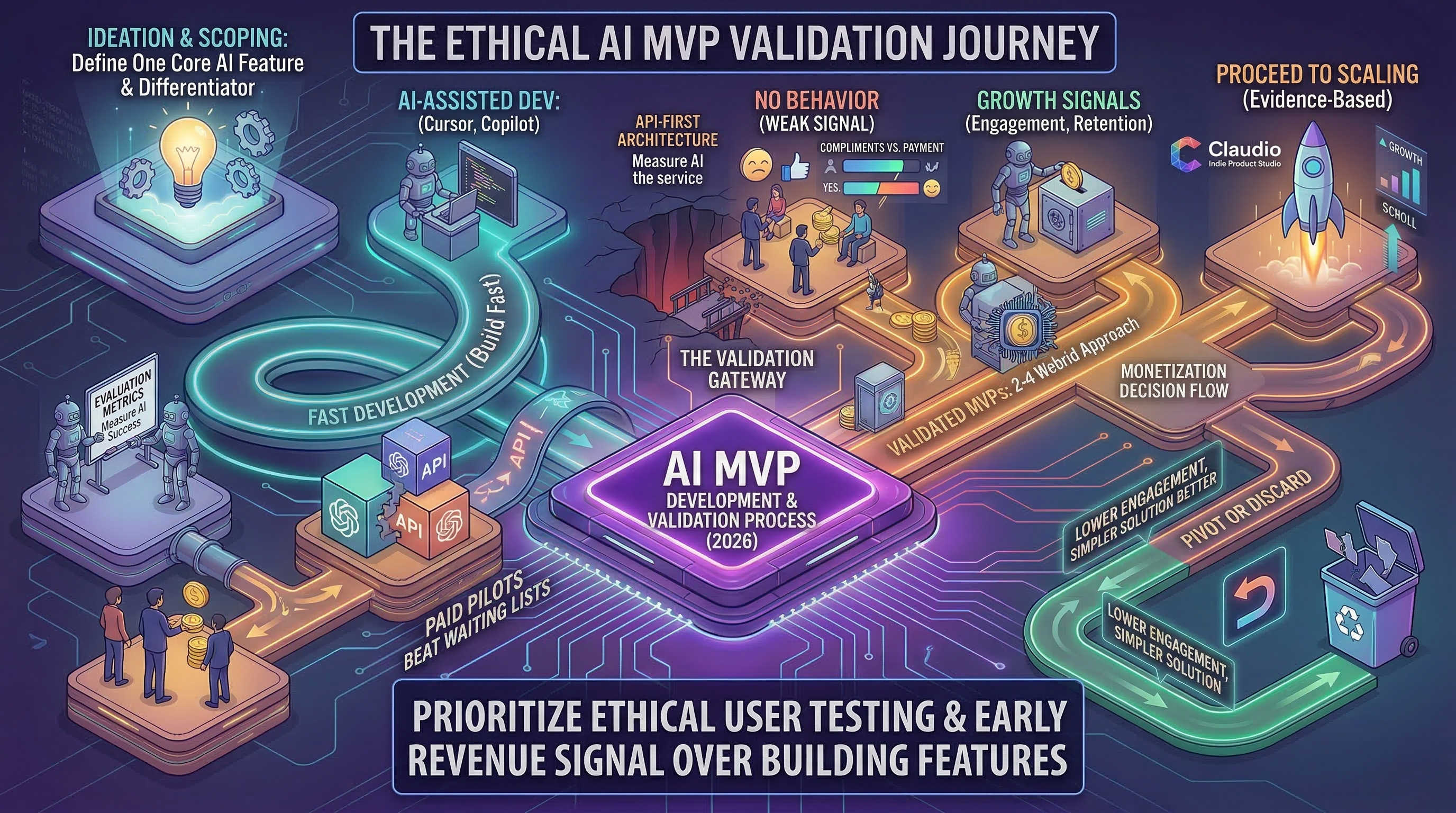
Building an AI MVP feels different from traditional software development. The promises are bigger, the unknowns are larger, and the temptation to overbuild is constant.
The goal remains the same: validate your hypothesis with minimum investment before committing more resources.
This guide shows you how to build an AI MVP that learns fast, costs less, and gives you clear signals on whether to continue or pivot.
Defining Your AI MVP Scope
The biggest mistake in AI MVP development is scope creep. You don’t need a perfect AI product—you need the smallest proof that your AI solves a real problem.
Core vs. Differentiation
Every AI MVP has two parts:
- Core AI functionality: The actual intelligence—prediction, generation, classification, or recommendation
- Differentiation: What makes your solution unique—UI, workflow, domain expertise, or data advantage
Your MVP should focus on the minimum viable version of differentiation. Everything else should use existing tools and APIs.
For example, if you’re building a meeting summarizer:
- Don’t build your own speech-to-text (use OpenAI Whisper API)
- Don’t build your own summarization model (use GPT-4 or Claude)
- Focus your MVP on the unique value: extracting action items, tracking decisions, or integrating with specific tools
This approach lets you validate the core hypothesis while using proven AI capabilities.
Development Approaches for 2026
AI-Assisted Development
Use AI coding tools (Cursor, GitHub Copilot, v0) to accelerate development:
- Frontend: AI generates UI components faster than manual coding
- Backend: AI scaffolds APIs, handles boilerplate, and writes tests
- Speed: 2-3x faster than traditional development
This approach maintains code quality for future scaling while dramatically reducing initial development time.
API-First Architecture
Build your MVP using existing AI APIs:
- OpenAI (GPT-4, GPT-4o)
- Anthropic (Claude)
- Google (Gemini)
- Open-source models via Replicate/HuggingFace
API-based MVPs are faster to build, easier to iterate, and let you switch providers based on performance and cost.
Hybrid Approach (Recommended)
Most successful AI MVPs combine:
- AI coding assistants for development speed
- Pre-built AI APIs for core functionality
- No-code tools for rapid testing of non-core features
This balances speed, quality, and cost.
Validating Before Building
The Validation Framework
Before writing code, establish your validation criteria:
- Problem validation: Do target users actually have this problem?
- Solution validation: Does your proposed solution address it?
- AI validation: Does AI improve the solution vs. non-AI alternatives?
- Pricing validation: Will users pay for this?
Practical Validation Methods
- Landing page test: Create a page describing your AI solution with pricing. Measure signups and waitlist conversions.
- Concierge MVP: Manually deliver the AI service before automating. Learn what users actually want.
- Wizard of Oz test: Show users the AI interface but handle requests manually behind the scenes.
- Paid pilot: Offer discounted early access in exchange for feedback and commitment.
The key is behavioral data, not compliments. People saying “that’s cool” means nothing. People giving you money or time means everything.
Cost Optimization Strategies
Development Costs
- Use AI coding assistants to reduce engineering hours
- Start with serverless architecture (pay per request)
- Leverage open-source libraries before building custom
AI API Costs
- Start with cheaper models (GPT-3.5, Haiku) during development
- Upgrade to premium models only for production
- Implement caching to reduce repeated calls
- Set usage alerts to catch runaway costs
Infrastructure Costs
- Use managed services (Vercel, Railway, Supabase) over self-hosted
- Start with the smallest viable infrastructure
- Scale only when you have validated demand
Common Pitfalls to Avoid
Over-Engineering
Don’t build features nobody asked for. Your MVP should feel almost embarrassing in its simplicity.
Ignoring Evaluation
AI systems need evaluation. How will you measure whether your AI is actually working? Define metrics before building.
Skipping Feedback Loops
AI MVPs need continuous user feedback. Build feedback mechanisms from day one.
Waiting for Perfect
Ship fast, learn faster. Perfect is the enemy of validated.
When to Pivot or Proceed
Signals to Proceed
- Users are actively using the product (not just signing up)
- Engagement metrics are growing week-over-week
- Users are requesting features or providing unsolicited feedback
- Some users are willing to pay
Signals to Pivot
- Low engagement despite marketing efforts
- Users don’t understand the value proposition
- AI isn’t meaningfully better than simpler alternatives
- Competition has solved the problem better
Need help scoping your AI MVP? Talk to our consultants for guidance.
If you want to understand the costs involved, read our AI MVP Cost Curve analysis.
For a broader view of AI development options, see AI vs No-code vs Low-code for MVPs.
Next Steps
Ready to build your AI MVP? Start with these actions:
- Define your one core AI feature: What’s the smallest thing that proves your hypothesis?
- Identify your differentiation: What makes this uniquely valuable?
- Choose your tech stack: Based on the approach that matches your resources
- Set validation metrics: What does success look like at 30/60/90 days?
- Build the minimum: Ship fast, measure, iterate
The AI MVP space moves fast. The winners are those who validate quickly and iterate based on real user signal—not the ones who build the most features.