
MVP Legal Checklist: Protect Your Startup from Day One (2026)
Essential legal requirements for launching your MVP. Covers intellectual property, data privacy, terms of service, and contracts every startup needs before going to market.
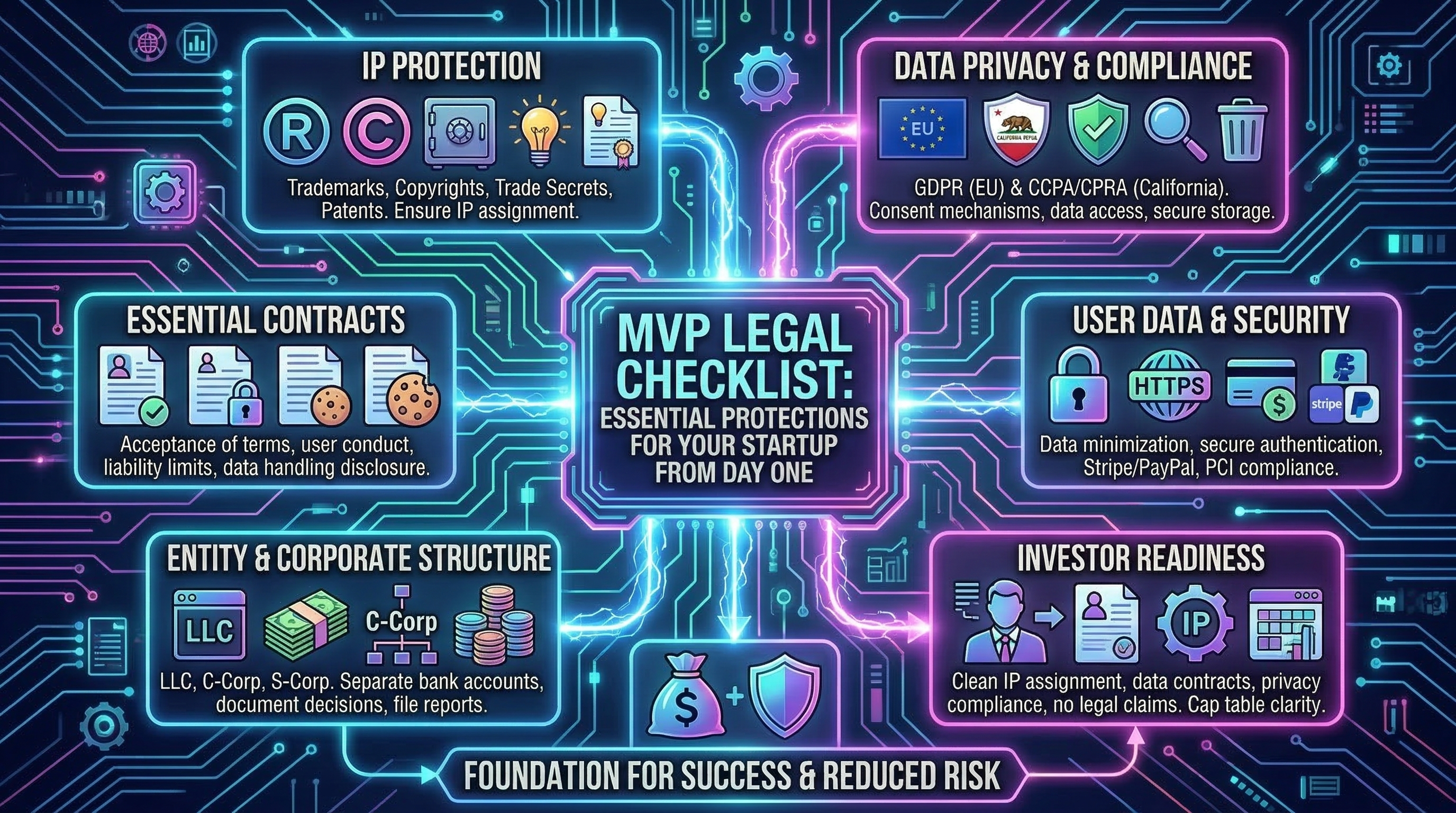
Legal isn’t the most exciting part of building an MVP. But getting it right early prevents costly problems later—and makes your startup fundable when you’re ready to raise.
This checklist covers the essential legal protections every MVP needs before launch.
For more on MVP validation and go-to-market, see our MVP Go-to-Market Strategy.
Intellectual Property Protection
Trademarks
Your brand name, logo, and product names should be trademarked.
- Search: Check USPTO (or your local office) for existing marks
- File early: Apply for trademark as soon as you’ve decided on branding
- Cost: $250-350 per class (US), varies internationally
For MVPs, at minimum ensure you’re not infringing on existing marks. Full trademark registration can wait until you’ve validated.
Copyrights
Your code, content, and creative works are automatically copyrighted.
- Original code: You’re the author by default
- Contributions: Ensure contributors assign rights to your company
- Content: Blog posts, documentation, marketing materials all protected
Trade Secrets
Processes, algorithms, and methods that give you competitive advantage:
- Keep internal documentation secure
- Use NDAs with employees and contractors
- Limit access to sensitive information
Patents
Rarely needed for MVPs. Patents are expensive ($15k-30k+), take years, and require novel inventions.
- Only pursue if you have truly novel technology
- Consider provisional patents for priority dates while deciding
Data Privacy and Compliance
GDPR (European Union)
If you have EU users, GDPR applies regardless of where you’re based:
- Lawful basis: Document why you process data (consent, contract, legitimate interest)
- User rights: Right to access, rectification, erasure, portability
- Data protection: Encryption, access controls, breach notification (72 hours)
- Privacy policy: Must be comprehensive and accessible
CCPA/CPRA (California)
California residents have specific rights:
- Right to know what data you collect
- Right to delete data
- Right to opt-out of data sales
- Non-discrimination for exercising rights
General Privacy Requirements
Even without specific regulations:
- Only collect data you actually need
- Store data securely
- Provide access and deletion mechanisms
- Be transparent about data practices
Your Privacy Policy must accurately reflect your actual practices.
Essential Contracts and Documents
Terms of Service
The contract between you and users. Must cover:
- Acceptance of terms
- Account responsibilities
- User conduct rules
- Intellectual property ownership
- Limitation of liability
- Disclaimer of warranties
- Indemnification
- Termination rights
- Dispute resolution
Privacy Policy
Discloses how you handle user data:
- What data you collect
- How data is used
- Third-party sharing
- Security measures
- User rights
- Contact information
Cookie Policy
Required if using cookies (most websites):
- Types of cookies used
- Purpose of each cookie
- Third-party cookies
- User consent mechanism
- How to opt-out
Disclaimers
Specific disclaimers based on your product:
- No professional advice (if providing recommendations)
- Accuracy of information
- Third-party links
- AI-generated content (if applicable)
Entity and Corporate Structure
Choose Your Entity Type
- LLC: Simpler, pass-through taxation, less formal
- C-Corp: Better for VC funding, stock options, scale
- S-Corp: Pass-through with some corporate structure benefits
Most VC-backed startups are C-Corps, but LLCs work for many service businesses and early-stage MVPs.
Corporate Formalities
Regardless of entity type:
- Maintain separate bank accounts
- Document major decisions
- Keep meeting minutes
- File annual reports
- Pay required fees and taxes
User Data and Security
Data Minimization
Only collect what you need:
- Review every data field you capture
- Remove unnecessary fields
- Anonymize where possible
Security Basics
- HTTPS everywhere
- Secure authentication (not storing passwords improperly)
- Access controls
- Regular backups
- Incident response plan
Payment Security
If handling payments:
- Use Stripe, PayPal, or similar (don’t store card data)
- PCI compliance (managed by payment processors)
- Clear refund policies
Investor Requirements
When raising funding, expect due diligence on:
- Clean IP assignment from all founders/contractors
- Customer and data contracts in place
- Privacy compliance documented
- No outstanding legal claims
- Cap table clarity
Getting these right early makes fundraising significantly smoother.
Quick Implementation Checklist
Before launch, verify:
- Terms of Service drafted and posted
- Privacy Policy drafted and posted
- Cookie policy (if applicable)
- Secure website (HTTPS)
- Payment processor integrated (if applicable)
- GDPR/CCPA compliance measures
- IP assignment from all contributors
- Business entity formed
- Bank account separated from personal
- Clear liability disclaimers
Need help with legal setup? Talk to our consultants who can connect you with startup legal resources.
For understanding the broader MVP development process, see How to Scope an MVP.
Don’t Skip the Basics
Legal protections aren’t optional—they’re foundational. The cost of getting them right early is minimal compared to the cost of fixing problems later.
Start with the essentials, document everything, and consult professionals for complex situations. Your future investors will thank you.