
MVP Pricing Strategy: How to Price Your Minimum Viable Product (2026)
Master MVP pricing strategy with proven frameworks for testing willingness to pay. Learn value-based, competitive, and dynamic pricing approaches for early-stage products.
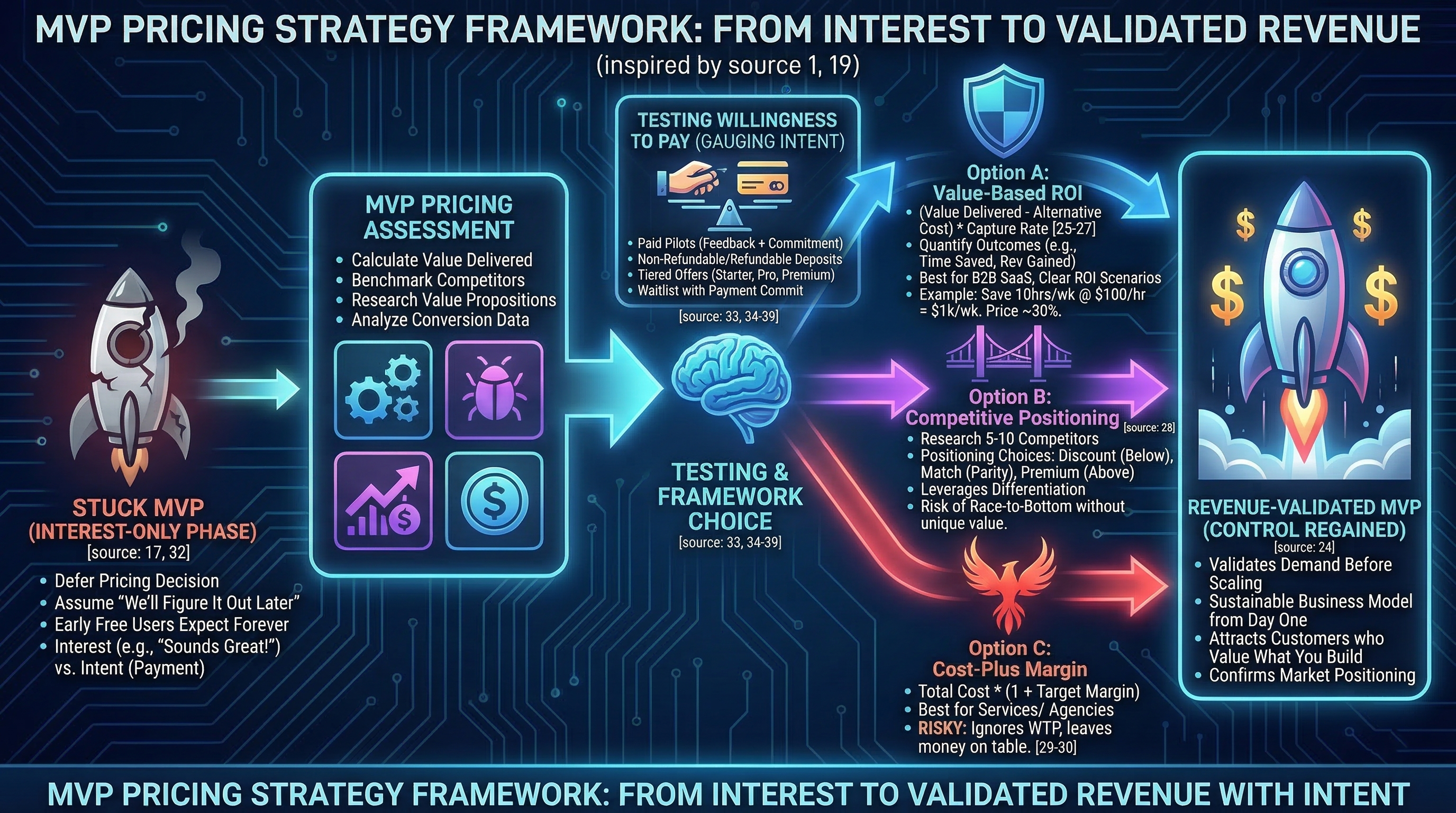
Pricing is often the last thing founders think about—and the most expensive mistake to fix later.
Most MVPs defer pricing decisions. “We’ll figure it out later,” they say. Later becomes never, and suddenly you have thousands of users who expect free forever.
This guide shows you how to approach MVP pricing strategically—testing willingness to pay early, choosing the right pricing model, and building a foundation for sustainable revenue.
For more detailed tactics on testing willingness to pay, see our guide on MVP Pricing & Packaging Testing.
Why Pricing Matters at MVP Stage
Your pricing communicates value. Too cheap, and users question your legitimacy. Too expensive, and you price out early adopters who could become advocates.
More importantly, pricing is a validation mechanism. Someone saying “I’d pay $50/month” means nothing. Someone actually paying $50/month means everything.
Testing pricing at the MVP stage:
- Validates real demand before you scale
- Creates a sustainable business model from day one
- Attracts customers who value what you build
- Establishes positioning in the market
Pricing Framework Options
Value-Based Pricing
Price based on the value you deliver, not your costs.
Best for: B2B SaaS, outcome-driven products, clear ROI scenarios
Method: Price = (Value Delivered - Alternative Cost) × Capture Rate
Example: If your tool saves 10 hours/week at $100/hour opportunity cost = $1,000/week value. At 30% capture rate, you could price at $300/month.
The key is quantifying your value in terms your customers understand. This requires deep understanding of your users’ alternatives and outcomes.
Competitive Pricing
Price relative to existing solutions.
Best for: Crowded markets, feature-parity products, markets with established pricing norms
Method: Research 5-10 competitors, position based on differentiation
Positioning options:
- Discount (20-30% below) for price-sensitive segments
- Match (at market) for parity positioning
- Premium (20-30% above) for differentiation
The risk is getting trapped in race-to-bottom pricing if you don’t have meaningful differentiation.
Cost-Plus Pricing
Price based on your costs plus margin.
Best for: Services, agencies, products with high variable costs
Method: Total Cost × (1 + Target Margin)
Risk: This approach ignores what customers are willing to pay. You might leave significant money on the table—or price yourself out of the market.
Testing Pricing at MVP Stage
The Interest vs. Intent Problem
People say they’ll pay. People rarely follow through.
- Interest: “That sounds great!” “I’d definitely pay for that.”
- Intent: Signing up with credit card, paying a deposit, committing budget
Your pricing tests should measure intent, not interest.
Testing Methods
Paid Pilots
Offer discounted early access in exchange for feedback and commitment.
- 50% off launch pricing
- Limited spots (creates urgency)
- Clear deliverable expectations
This tests both willingness to pay and product-market fit.
Deposits
Ask for refundable or non-refundable deposits to gauge commitment.
- Refundable deposits: Lower barrier, tests serious interest
- Non-refundable deposits: Higher commitment, stronger signal
Tiered Offers
Test multiple price points simultaneously.
- Starter ($X): Basic features
- Pro ($2X): Core value
- Premium ($3X): Full suite
Conversion data tells you which resonates.
Waitlist with Pricing
Require email + credit card to join waitlist.
Even without charging, this tests commitment level.
Choosing the Right Model
Subscription
Best for: Ongoing value delivery, SaaS products
Considerations:
- Predictable revenue
- Requires continuous value delivery
- Churn is the enemy
One-Time
Best for: Discrete deliverables, tools with finite use cases
Considerations:
- Simpler for customers to commit
- Requires constant new customer acquisition
- Higher LTV needed to sustain
Usage-Based
Best for: Infrastructure, APIs, variable value delivery
Considerations:
- Aligns cost with value
- Requires usage tracking infrastructure
- Harder to predict revenue
Hybrid
Most successful MVPs evolve into hybrid models:
- Base subscription + usage overages
- One-time setup + recurring services
- Tiered subscriptions with add-ons
Positioning and Communication
Value Justification
Your price needs justification. Build the case:
- Quantified outcomes (time saved, revenue gained, costs reduced)
- Comparison to alternatives (hiring, manual process, competitor)
- Risk reduction (guarantees, trials, support)
Early Adopter Pricing
Reward early supporters:
- Founding member pricing (locked in forever)
- Early access to features
- Direct access to founders
- Input on product direction
This creates advocates who spread the word.
Handling Price Objections
When prospects push back:
- Probe: Understand the real objection
- Demonstrate: Show specific value proof points
- Offer alternatives: Payment plans, starter tiers, custom deals
- Know when to walk: Some prospects aren’t your customers
When to Raise Prices
Signals It’s Time
- Demand exceeds supply consistently
- You’re turning away customers
- Feature requests indicate need for premium tier
- Competitors raised prices
How to Raise
- Lock in existing customers at old rates
- Introduce new tiers rather than raising across the board
- Communicate value increases justifying price
- Give advance notice
Need help determining your pricing strategy? Talk to our consultants for personalized guidance.
For understanding what happens after pricing validation, see From MVP to Product Decisions.
Implementation Checklist
Use this checklist to implement your MVP pricing:
- Define your value proposition in quantifiable terms
- Research 5-10 competitor price points
- Choose your primary pricing framework
- Design 2-3 test price points
- Create a testing mechanism (pilot, deposit, tier)
- Set success criteria for pricing tests
- Build conversion tracking
- Plan your early adopter offer
- Document learnings and iterate
Pricing isn’t set-it-and-forget-it. It’s a continuous experiment that informs your product, positioning, and business model.