
AI MVP Cost Curve: Month 0-12 Breakdown (Upfront + Ongoing 2026)
AI-built MVPs feel cheap month one—then costs quietly compound. See the real 12-month cost curve and why cheap starts lead to expensive finishes. Get started today.

Most founders who try to build an MVP using AI builders, no-code, or low-code tools describe the same initial experience: it feels incredibly cheap and fast.
I’ve watched teams celebrate their “$500 MVP” only to spend $15,000 fixing it six months later. The math only looks good if you ignore what happens after week four.
In the first days, progress is visible. Screens appear, flows connect, and a working demo emerges with minimal effort. Compared to hiring a team or a studio, the contrast is striking.
If you’re considering building an MVP, our MVP development services can help you avoid these cost traps with upfront architecture planning.
But then something changes.
Two or three weeks later, iteration slows down, costs rise, and progress feels harder than it should. This article explains why that happens with real cost data, and how to recognize the pattern before it becomes a problem.
Want to avoid the cost curve trap? Talk to our consultants for a cost-effective approach.
If you want the broader context on AI-driven MVPs, start here:
The Early Phase: Why Everything Feels So Cheap
AI and no-code tools are optimized for one thing: getting to a first version quickly.
At this stage:
- Scope is fuzzy
- Edge cases are ignored
- Users are hypothetical
- Data volume is tiny
That’s why the system feels responsive and costs feel under control. Most work happens on the surface, where AI excels.
This phase is not a lie. It’s just incomplete.
Typical Month 1 costs: €50-€200 (tool subscriptions + minimal usage).
The Shift: When Real Requirements Appear
The moment you move beyond the demo, reality shows up.
Typical triggers include:
- Real users signing up
- Payments or subscriptions
- Different user roles (admin, user, staff)
- Integrations with external tools (Stripe, email, CRM)
- Compliance or data ownership concerns
Each new requirement introduces constraints. Constraints reduce the effectiveness of purely generative approaches.
If you’re unsure whether your MVP is still just a demo, this article helps clarify the difference:
Typical Month 2-3 costs: €300-€600 (usage spikes as iteration increases).
The Hidden Cost Curve: Month-by-Month Breakdown
AI/No-Code MVP Cost Curve (12 months)
| Month | Activity | Monthly Cost | Cumulative Cost | Notes |
|---|---|---|---|---|
| 1 | Initial build (demo) | €200 | €200 | Fast progress, low usage |
| 2 | Add payments + roles | €400 | €600 | First iteration spike |
| 3 | Fix bugs, add integrations | €500 | €1.100 | Debugging takes 2x time |
| 4 | User feedback iteration | €600 | €1.700 | Every fix breaks 2 things |
| 5 | Performance fixes | €500 | €2.200 | Platform hitting limits |
| 6 | Hardening attempt | €400 | €2.600 | Manual workarounds |
| 7 | Feature request backlog | €300 | €2.900 | Velocity dropping |
| 8 | Migration consideration | €200 | €3.100 | Evaluating rebuild |
| 9-12 | Maintenance (no growth) | €200/mo | €3.900 | Stuck, can’t add features |
Total Year 1: €3.900 (but velocity near zero by Month 9).
Custom MVP Cost Curve (12 months)
| Month | Activity | Monthly Cost | Cumulative Cost | Notes |
|---|---|---|---|---|
| 1-2 | Build MVP (partner) | €7.500/mo | €15.000 | Upfront investment |
| 3-12 | Maintenance + hosting | €150/mo | €16.500 | Stable, can iterate |
Total Year 1: €16.500.
Break-Even Analysis: AI vs Custom
Crossover point: Month 8.
- Month 1-7: AI cheaper (€2.900 vs €15.150)
- Month 8: Costs equal (€3.100 AI vs €15.300 custom)
- Month 9-12: Custom cheaper (€3.900 AI stuck vs €16.500 custom functional)
Critical insight: AI appears cheaper for first 7 months, but if you’re still building after Month 8, custom would have been cheaper and faster.
Cost Curve Graph Visualization
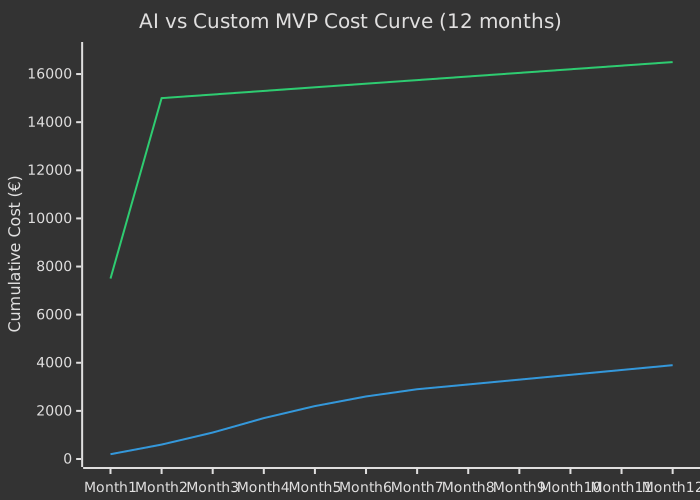
Break-even at Month 8: After this point, custom MVP is cheaper per month (€150 maintenance vs €200+ AI stuck costs).
Token Cost Explosion: Real Examples
Example 1: ChatGPT API for “AI-powered” features
Scenario: B2C app uses ChatGPT API for content generation (blog summaries, email drafts).
Month 1 usage: 10 users × 20 requests/day × €0.002/request = €4/day = €120/month.
Month 3 usage (100 users): 100 users × 20 requests/day × €0.002 = €40/day = €1.200/month.
Month 6 usage (500 users): 500 users × 20 requests/day × €0.002 = €200/day = €6.000/month.
Cost explosion: 10x users = 50x cost increase (€120 → €6.000) because per-request pricing scales linearly with usage.
Alternative: Custom MVP with cached responses or cheaper LLM (Claude Haiku €0.00025/request) = €600/month at 500 users (10x cheaper).
Example 2: No-code platform (Bubble) hitting usage limits
Scenario: SaaS dashboard built on Bubble.
Month 1: 20 users, 5k database rows, €100/month plan = €100/month.
Month 4: 100 users, 50k rows, hitting free tier limit → upgrade to €300/month plan.
Month 6: 500 users, 200k rows, need “Professional” plan → €600/month.
Month 9: 1k users, 500k rows, hitting Professional limit → need “Production” plan → €1.200/month.
Cost explosion: 50x users = 12x cost increase (€100 → €1.200). Plus performance degraded (5-10 second load times at 500k rows).
Alternative: Custom MVP with Postgres (Supabase €25/month) = handles 10M rows, no performance degradation.
Example 3: Iteration-heavy debugging (AI code generation)
Scenario: Founder uses Cursor AI (€20/month) + Claude API to build marketplace MVP.
Month 1: Building features, 500 AI requests = €20 + €10 API = €30/month.
Month 3: Debugging phase (every fix breaks 2 things). 2.500 AI requests = €20 + €50 API = €70/month.
Month 5: Heavy iteration (user feedback). 5.000 AI requests = €20 + €100 API = €120/month.
Cost explosion: 10x iteration = 4x cost increase (€30 → €120). Founder time also 3x higher (debugging vs building).
Alternative: Partner build with tests + staging = no debugging loop, fixed €15k cost.
Why This Becomes Technical Debt
Technical debt is not about bad code. It’s about decisions that make future change harder.
In AI-built MVPs, debt often comes from:
- Inconsistent architecture (each feature uses different patterns)
- Duplicated logic (same validation in 5 places)
- Unclear data models (add columns randomly, no migrations)
- Behavior spread across UI layers (business rules in React components)
If these symptoms sound familiar, review:
For a neutral definition of technical debt, IBM provides a useful overview: https://www.ibm.com/think/topics/technical-debt
When the Cost Curve Crosses the Danger Line
The real problem is not that costs rise. It’s that costs rise while progress slows.
This is usually the point where founders say:
> “We’ll clean it up later.”
That moment matters. The best approach is to address hardening early:
Subscriptions, Tokens, and the Illusion of Predictability
Most AI tools rely on:
- Monthly subscriptions (€20-€300/month)
- Usage-based pricing (per request, per user, per row)
- Token or credit top-ups
This model feels predictable at first. But iteration-heavy development changes the equation.
When each fix requires multiple attempts, usage costs grow exactly when productivity drops.
This creates a loop where founders hesitate to abandon the tool because so much has already been built, even if progress stalls.
Hidden Costs: Time Opportunity Cost
Founder time breakdown (AI MVP vs Custom)
| Activity | AI MVP (Months 1-6) | Custom MVP (Months 1-2) |
|---|---|---|
| Building features | 40% (80h) | 10% (5h review) |
| Debugging issues | 40% (80h) | 5% (2h) |
| Learning tools | 10% (20h) | 0h (partner handles) |
| Sales/Marketing | 10% (20h) | 85% (42h) |
| TOTAL TIME | 200h (5 weeks full-time) | 50h (1.5 weeks) |
Opportunity cost: Founder spent 150h extra on AI MVP (debugging + learning) vs focusing on sales. At €100/h founder rate = €15.000 hidden cost.
How to Avoid the Trap
You don’t need to avoid AI tools. You need to change how you use them.
Safe patterns include:
- Limiting AI usage to discovery and prototyping (first 2 weeks)
- Defining a clear data model early (before any AI code generation)
- Hardening core flows before adding features (auth, payments, error handling)
- Making architectural decisions explicit (document why, not just what)
A practical checklist is here:
DIY vs Partner: The Cost Perspective
DIY feels cheaper because the cost is fragmented and spread over time.
Working with a partner feels more expensive because costs are explicit.
Only one of these is predictable.
To evaluate objectively:
Conclusion: Cheap Is About Timing, Not Total Cost
AI-built MVPs feel cheap because they compress the beginning of the journey.
What matters is the middle.
Remember:
- Cost curve: AI Month 1-7 cheaper (€2.900 vs €15.150 custom), but breaks even at Month 8. By Month 12, custom cheaper and functional (€16.500 vs €3.900 stuck).
- Token explosions: ChatGPT API 10x users = 50x cost (€120 → €6.000/month), Bubble 50x users = 12x cost (€100 → €1.200), iteration-heavy AI 10x requests = 4x cost (€30 → €120).
- Hidden costs: Founder opportunity cost 150h debugging @ €100/h = €15.000 (could’ve been spent on sales).
- Break-even: AI appears cheaper first 7 months, but if building >8 months, custom would’ve been faster + cheaper.
If your MVP is meant to evolve into a product, the cheapest path is usually the one that keeps velocity stable over time—not the one that feels fastest on day one.