
Prototype to Product Hardening Checklist: Priority Matrix (2026)
Prototype to product is the hard part. Get a hardening checklist with survival-critical fixes, scale-ready infrastructure, and realistic timelines. Read the full guide.
AI builders, no-code platforms, and low-code tools are excellent at answering one question:
> “Can this work?”
A real product must answer a harder one:
> “Can this keep working while we change it?”
The gap between those two questions is called hardening. It’s not polish. It’s not over-engineering. It’s the minimum structure required to iterate without breaking everything.
Need help hardening your MVP? Talk to our development team for hardening support.
If you’re still orienting yourself in this topic, start from the main guide:
What “Hardening” Actually Means
Hardening means making your MVP:
- Safe to change (fix one bug without breaking 2 others)
- Predictable under load (100 users vs 1,000 users)
- Understandable by more than one person (not “black box”)
- Observable when things go wrong (errors tracked, not silent failures)
Without hardening, each new feature increases risk instead of value.
Why AI-Built MVPs Often Skip Hardening
AI tools optimize for:
- Speed (ship in days)
- Visible progress (demo works)
- Happy paths (user does everything right)
They do not optimize for:
- Edge cases (user enters invalid data, API times out)
- Long-term maintenance (someone else reads code 6 months later)
- Architectural coherence (consistent patterns across codebase)
- Ownership clarity (who owns this decision?)
This is not a flaw. It’s a trade-off. Problems arise when founders don’t realize the trade-off exists.
If you’re already seeing friction, scan this first:
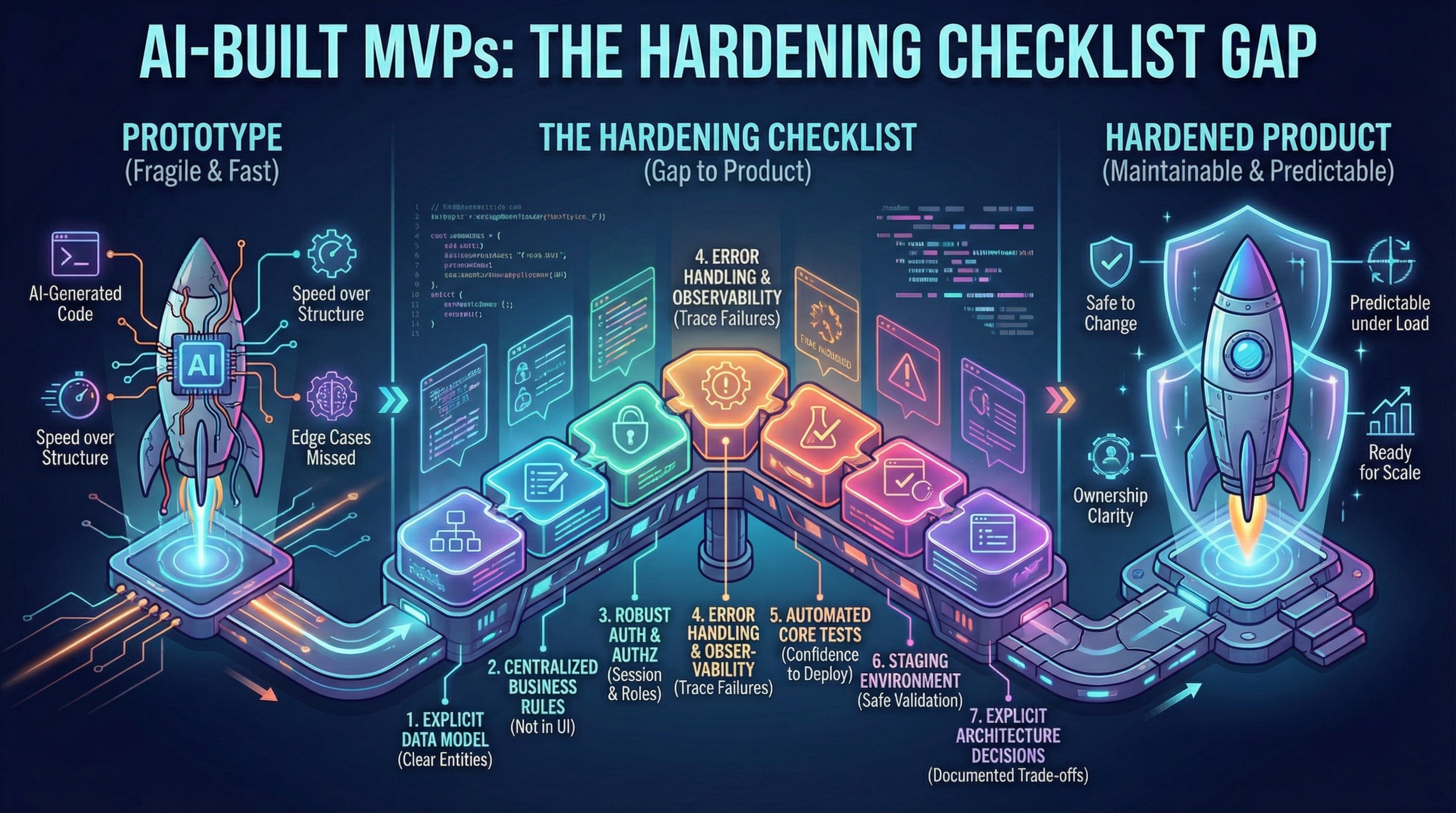
The Prototype → Product Gap (Visual Overview)

The earlier you harden, the cheaper it is.
The Hardening Checklist (Priority Matrix)
Critical (Must-Have Before First Users)
| Item | Why Critical | Time to Fix | Cost |
|---|---|---|---|
| 1. Auth + session handling | Users locked out = churn | 1-2 days | €600-€1k |
| 2. Error tracking (Sentry) | Can’t fix bugs you don’t see | 2-4 hours | €200-€400 |
| 3. Staging environment | Production breaks = downtime | 4-6 hours | €300-€500 |
| 4. Database backups | Data loss = business over | 2-3 hours | €150-€300 |
| 5. Payment webhooks handling | Lost payments = lost revenue | 1-2 days | €600-€1k |
Total Critical: 3-5 days, €1.850-€3.200.
Important (Before Revenue or >50 Users)
| Item | Why Important | Time to Fix | Cost |
|---|---|---|---|
| 6. Automated tests (core flows) | Catch regressions before deploy | 2-3 days | €1k-€1.5k |
| 7. Centralized business rules | Rules scattered = every change breaks | 1-2 days | €600-€1k |
| 8. Logging (structured) | Debug issues without reproducing | 1 day | €500-€800 |
| 9. Role-based permissions | Avoid security holes | 1-2 days | €600-€1k |
| 10. Clear data model | Fuzzy schema = slow iterations | 1-2 days | €600-€1k |
Total Important: 6-10 days, €3.300-€5.300.
Nice-to-Have (Scale Phase)
| Item | Why Nice-to-Have | Time to Fix | Cost |
|---|---|---|---|
| 11. Performance monitoring | Know before users complain | 1 day | €500-€800 |
| 12. Feature flags | Roll out features safely | 1 day | €500-€800 |
| 13. CI/CD pipeline | Deploy confidence | 1-2 days | €600-€1k |
| 14. Documentation | Onboard new devs faster | 2-3 days | €1k-€1.5k |
Total Nice-to-Have: 5-7 days, €2.600-€4.100.
Full Hardening Cost Summary
- Critical only: 3-5 days, €1.850-€3.200 (survival minimum)
- Critical + Important: 9-15 days, €5.150-€8.500 (product-ready)
- All items: 14-22 days, €7.750-€12.600 (scale-ready)
Recommended: Critical + Important (€5k-€8.5k) before first revenue.
Week 1-4 Hardening Roadmap
Week 1: Critical Hardening (Survival)
Day 1-2: Auth + session handling
- Fix password reset flow (broken in 80% of AI MVPs)
- Add session expiry (prevent zombie sessions)
- Test login/logout edge cases (expired tokens, concurrent sessions)
Day 3: Error tracking setup
- Integrate Sentry (free tier = 5k events/month)
- Add user context (which user hit the bug)
- Configure alerts (Slack notifications for critical errors)
Day 4: Staging environment
- Clone production setup
- Configure separate database (staging data ≠ production)
- Add deploy preview (test before pushing to prod)
Day 5: Database backups + payment webhooks
- Automate daily backups (test restore procedure)
- Handle Stripe webhooks (payment.succeeded, payment.failed)
- Add idempotency keys (prevent duplicate charges)
Deliverable: MVP survives real users without critical failures.
Cost: €1.850-€3.200.
Week 2: Important Hardening (Product-Ready)
Day 6-8: Automated tests (core flows)
- Write tests for: signup, login, payment, core feature
- Use Vitest (fast) or Jest (mature)
- Run tests in CI (GitHub Actions, Vercel)
Day 9-10: Centralize business rules
- Move validation logic out of UI components
- Create
rules/folder (pricing, permissions, workflows) - Document rules in plain English (not just code)
Day 11: Logging (structured)
- Switch from
console.logto structured logs (JSON format) - Add request IDs (trace user journeys)
- Setup log aggregation (Logtail, CloudWatch)
Day 12-13: Role-based permissions
- Define roles (admin, user, staff)
- Implement backend checks (don’t trust frontend)
- Test edge cases (role changes mid-session)
Day 14-15: Clear data model
- Document schema (tables, relationships, constraints)
- Add database migrations (track schema changes)
- Normalize data (reduce duplication)
Deliverable: MVP ready for revenue and safe iteration.
Cost: €3.300-€5.300 (cumulative €5.150-€8.500).
Week 3-4: Nice-to-Have (Scale-Ready)
Optional if planning to scale >1k users in next 6 months.
Day 16: Performance monitoring (Vercel Analytics, Plausible)
Day 17: Feature flags (LaunchDarkly free tier, Posthog)
Day 18-19: CI/CD pipeline (automate tests + deploy)
Day 20-22: Documentation (architecture decisions, API docs, README)
Deliverable: MVP ready for team growth and high load.
Cost: €2.600-€4.100 (cumulative €7.750-€12.600).
When to Harden (Timing Matters)

Harden before:
- Users depend on the system (>10 active users)
- Money flows through it (first paid plan launched)
- Scope explodes (team grows, features multiply)
Don’t harden if:
- Still validating idea (<10 test users)
- Pivot likely (might rebuild anyway)
- Prototype-only (throwaway demo)
Critical Hardening: Detailed Breakdown
1. A Clear and Explicit Data Model
Ask yourself:
- Are core entities clearly defined? (User, Order, Product)
- Are names consistent across the system? (userId vs user_id vs user-id)
- Is ownership of data explicit? (who can read/write this table?)
UI-first development often produces fragmented data models. Over time, that makes every change harder.
If you’re unsure what a solid MVP foundation looks like:
2. Centralized Business Rules
Business rules hidden inside UI logic are fragile.
Examples include:
- Who can edit what (permissions)
- What happens on invalid input (validation)
- State transitions and side effects (order placed → email sent)
Rules should be centralized and documented so they can be changed safely.
3. Authentication and Authorization (Not Just “Login Works”)
Hardening requires more than a working login screen:
- Session handling (expiry, refresh tokens)
- Password reset flows (email verification, token expiry)
- Role separation (admin vs user)
- Permission checks on the backend (don’t trust frontend)
Security debt compounds quickly and is expensive to fix later.
4. Error Handling and Observability
Ask:
- Do you know when something breaks? (error tracking)
- Can you trace failures? (logging with context)
- Do users see meaningful error messages? (not “Error 500”)
Without observability, problems stay hidden until users complain.
External reference: https://martinfowler.com/articles/patterns-of-distributed-systems/observability.html
5. Automated Tests for Core Flows
You don’t need full coverage. You do need confidence.
At minimum, core flows should be protected by automated tests so that iteration doesn’t reintroduce old bugs.
Without tests, teams often slow down because they’re afraid to deploy.
6. A Staging Environment
If you deploy directly to production, every release is a gamble.
A staging environment allows:
- Realistic testing (same stack as production)
- Safe validation of changes (catch bugs before users see them)
- Controlled releases (test with 5 beta users first)
This single step dramatically reduces risk.
7. Explicit Architecture Decisions
Hardening does not require long documents. It requires explicit decisions:
- Why this architecture (monolith vs microservices)
- Why this trade-off (performance vs simplicity)
- Why this shortcut (tech debt we accept)
Written decisions keep systems understandable over time.
DIY vs Partner: Who Should Do the Hardening?
DIY hardening works when:
- You understand the system deeply (wrote most of the code)
- Scope is controlled (<5 features)
- You can invest time in structure (not firefighting bugs)
Partner-led hardening is safer when:
- Velocity is already dropping (every change breaks something)
- Regressions are frequent (fixed bugs reappear)
- Ownership is unclear (no one knows why it works)
- Predictability matters (fixed cost, fixed timeline)
To evaluate objectively:
How We Approach Hardening at The Byte-sized
We don’t treat hardening as a phase you postpone.
We:
- Harden the core loop early (Week 1-2 of every MVP)
- Keep scope explicit (document what’s in/out)
- Use AI as an accelerator, not an autopilot (human-led decisions)
- Make progress visible through weekly demos (no black box)
- Document decisions in plain English (not just code comments)
If transparency matters to you:
Conclusion: Hardening Is Cheaper Than Rescue
Hardening is not bureaucracy. It’s insurance.
The earlier you invest in structure, the less you pay later—in time, money, and stress.
Remember:
- Priority matrix: Critical 3-5 days €1.8k-€3.2k (survival), Important 6-10 days €3.3k-€5.3k (product-ready), Nice-to-Have 5-7 days €2.6k-€4.1k (scale-ready).
- Week 1-4 roadmap: Week 1 critical (auth, errors, staging, backups, payments), Week 2 important (tests, centralized rules, logging, permissions, data model), Week 3-4 nice-to-have (monitoring, feature flags, CI/CD, docs).
- Timing: Harden before >10 active users or first revenue. Don’t harden if still validating (<10 test users).