
First MVP Demo vs Real Product: The 60% Hidden Work (2026 Cost Gap)
Demos are easy—2 weeks. Real users arrive and everything breaks. Learn why demos are deceptive and when it's safe to ship vs. when to wait. Get started today.
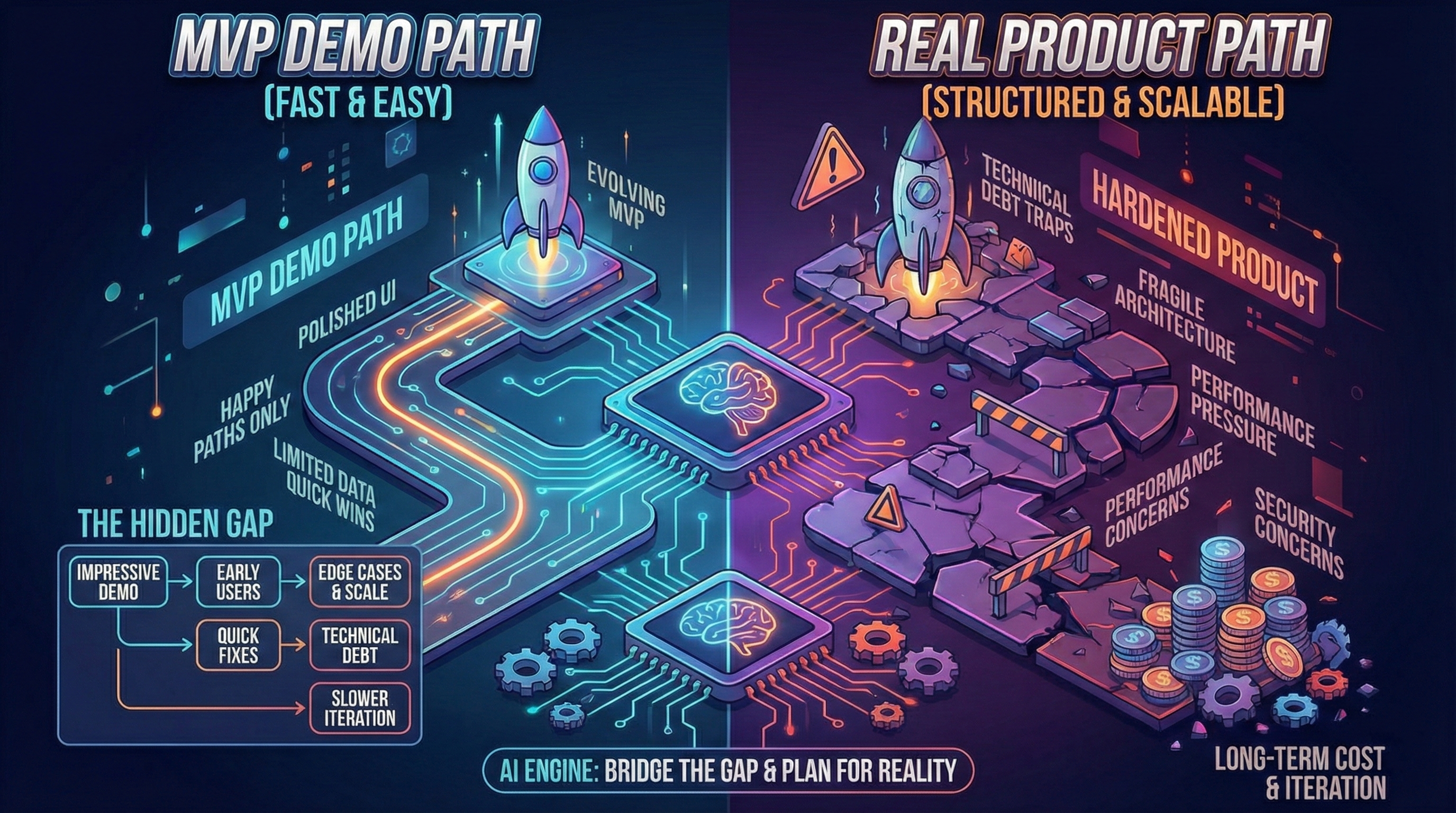
Every founder loves the first MVP demo.
We’ve built dozens of MVPs, and I still remember the rush of that first demo—everything works perfectly because I’ve tested every click. Then week two hits, and real users break everything.
It feels like magic: 2 weeks, and you have a working app.
Then reality shows up:
- “Why can’t users reset passwords?”
- “Payment worked in demo, now it’s broken.”
- “App crashes when two users edit same thing.”
This article explains why demos are easy and what makes products hard.
If you’re building an MVP and want to avoid the demo-to-product gap, our development team can help you plan for the hidden 60%.
For context:
Demo vs Product: Feature Comparison
| Feature | Demo (Week 2) | Product (Week 6-8) |
|---|---|---|
| Auth | Login page works | Password reset + email verification + session expiry + role permissions |
| Payments | Stripe test mode | Webhooks + idempotency + refunds + failed payment handling |
| Data | 10 test records | Migrations + backups + data validation + referential integrity |
| Errors | Ignored (refresh page) | Tracked (Sentry) + user-friendly messages + logging + alerts |
| UI | Desktop only | Responsive (mobile, tablet) + loading states + empty states |
| Performance | 1 user (you) | 100 users (concurrent) + caching + lazy loading + query optimization |
| Deployment | Local machine | Staging + production + CI/CD + rollback strategy |
| Security | API keys in code | Environment variables + HTTPS + input sanitization + SQL injection prevention |
Insight: Demo = 40% of work. Product = 60% hardening (invisible work).
Why Demos Feel Fast
Demo optimizes for:
- Happy path: User does everything right.
- Single user: No concurrency issues.
- No edge cases: “What if payment fails?” → ignored.
- No monitoring: If it breaks, you don’t know (until user complains).
Example: Checkout flow demo.
- User clicks “Buy” → Stripe API called → success → order created.
- Looks perfect in demo.
What’s missing:
- What if Stripe API times out?
- What if user clicks “Buy” twice?
- What if payment succeeds but order creation fails?
- What if user’s card declines?
Demo ignores all 4 cases. Product handles them.
Hidden Work: What Takes 60% of Time
1. Error Handling (2-3 weeks)
Demo: API call fails → app crashes → “Oops, something went wrong.”
Product:
- Try-catch every API call.
- User-friendly error messages (“Payment failed. Card declined. Try another card.”).
- Logging (“User X, order Y, Stripe error: card_declined at 2026-02-19 12:45”).
- Alerts (Slack notification: “5 payment failures in last 10 minutes”).
Time: 20-30 hours (15-20% of total).
2. Edge Cases (1-2 weeks)
Demo: User does A → B → C (linear flow).
Product: User does A → C (skips B), or A → A → B (repeats A), or back button.
Example: Multi-step form.
- Demo: Step 1 → Step 2 → Step 3 → Submit.
- Product:
- What if user refreshes at Step 2? (Save progress.)
- What if user goes back to Step 1 and changes data? (Re-validate Step 2.)
- What if user opens form in 2 tabs? (Handle concurrency.)
Time: 15-20 hours (10-15% of total).
3. Testing (1-2 weeks)
Demo: Manual testing (“It works on my machine”).
Product:
- Automated tests (signup, login, payment, core feature).
- Test edge cases (empty inputs, duplicate emails, expired tokens).
- Regression tests (prevent old bugs from coming back).
Time: 15-25 hours (10-20% of total).
4. Performance (1 week)
Demo: 1 user, 10 records, instant load times.
Product: 100 users, 10k records, need optimization.
Optimizations:
- Database indexes (speed up queries).
- Caching (Redis for frequently accessed data).
- Lazy loading (load images on scroll, not all at once).
- Query optimization (N+1 queries → batch queries).
Time: 8-15 hours (5-10% of total).
5. Security (1 week)
Demo: API keys hardcoded, no input validation.
Product:
- Environment variables (API keys in
.env, not code). - Input sanitization (prevent SQL injection, XSS).
- HTTPS (SSL certificate).
- Rate limiting (prevent abuse).
Time: 8-12 hours (5-10% of total).
6. Deployment (1 week)
Demo: npm run dev on local machine.
Product:
- Staging environment (test before production).
- CI/CD pipeline (automated deploy on Git push).
- Rollback strategy (if deploy breaks, revert fast).
- Monitoring (uptime alerts, error tracking).
Time: 8-12 hours (5-10% of total).
Timeline: Demo vs Product
Demo timeline (2 weeks):
- Week 1: Architecture + basic UI.
- Week 2: Core feature + happy path.
Result: Works in controlled demo (1 user, no edge cases).
Product timeline (6-8 weeks):
- Week 1: Architecture + planning.
- Week 2-4: Core features + UI.
- Week 5: Error handling + edge cases + testing.
- Week 6: Performance + security + deployment.
- Week 7-8: Bug fixes + handoff.
Result: Works for 100 users, handles errors, scales to 1k users.
Cost: Demo vs Product
| Phase | Time | Cost @ €125/h |
|---|---|---|
| Demo (happy path) | 40h | €5k |
| Hardening (errors, tests, security) | 60h | €7.5k |
| Post-launch (fixes, support) | 20h | €2.5k |
| TOTAL Product | 120h | €15k |
Insight: Demo costs €5k (40h). Product costs €15k (120h). Hardening = 60% of work. For a full breakdown of what these tiers look like in practice, see MVP pricing and packaging.
Why Founders Underestimate Hardening
What founders see: Demo works in 2 weeks → “Why does production take 6-8 weeks?”
What founders don’t see:
- Error handling (invisible until it breaks).
- Edge cases (only appear with real users).
- Testing (prevents future bugs, no immediate visible benefit).
- Performance (fast with 10 records, slow with 10k).
- Security (invisible until hacked).
Result: Founders push for “just ship demo.” Then 3 months later: bugs, downtime, security breach, rebuild. The AI MVP cost curve shows exactly how this pattern plays out month by month.
When to Ship Demo vs Wait for Product
Ship demo if:
- <10 test users (friends, not paying customers).
- Validation-only (“Would you use this?” not “Please pay $9/month”).
- Okay with downtime (“Sorry, fixing bugs, back in 1 hour”).
Wait for product if:
- >10 active users (reputational risk if broken).
- Money involved (payments, subscriptions).
- Sensitive data (healthcare, finance).
Conclusion: Demos Are Prototypes, Products Are Systems
Demo answers: “Can this work?”
Product answers: “Can this keep working?”
The gap is 60% of the work—and invisible until you need it.
Remember:
- Demo = 2 weeks, €5k, 1 user, happy path only.
- Product = 6-8 weeks, €15k, 100 users, errors handled, tests written, secure, scalable.
- Hardening = 60% of time (error handling, edge cases, testing, performance, security, deployment).