
10 Technical Debt Signs: When Your MVP Becomes Unmaintainable (2026)
Technical debt accumulates quietly through friction and hesitation. Learn the 10 warning signs before debt cost exceeds fix cost. Read the full guide.
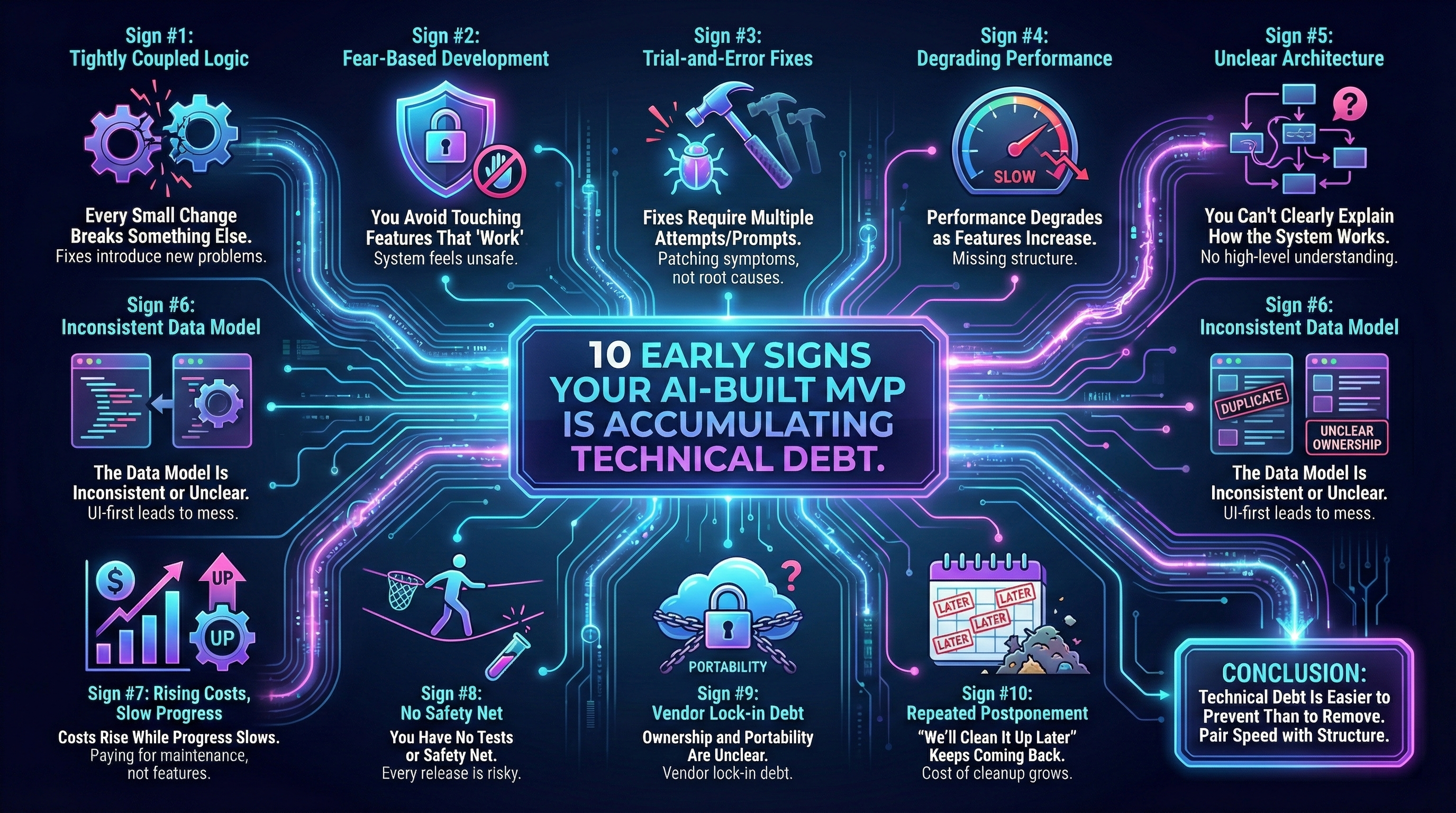
Many founders turn to AI builders, no-code, or low-code tools to move faster. At first, everything feels smooth: features appear quickly, costs seem under control, and progress is visible.
Then, gradually, things start to feel… heavier.
Small changes take longer than expected. Fixes introduce new problems. Costs go up while velocity goes down. These are not random issues—they are early symptoms of technical debt.
If you’re seeing these signs in your MVP, talk to our development team about addressing technical debt.
If you want the broader context, start from the pillar article:
What Technical Debt Means in Practice
Technical debt is the future cost of today’s shortcuts.
In an MVP, some shortcuts are intentional and healthy (see MVP tech stack). The problem begins when shortcuts accumulate accidentally—without visibility, ownership, or a plan to pay them back.
AI-generated systems are especially prone to this because they optimize for immediate results, not long-term coherence.
Good debt (intentional):
- Manual admin operations (automate later)
- Simplified data models (refactor when patterns clear)
- Basic error handling (improve after validation)
Bad debt (accidental):
- No separation between environments (dev/staging/prod)
- Tightly coupled logic (change one thing, breaks another)
- No migration strategy (database schema changes impossible)
Sign #1: Every Small Change Breaks Something Else
If updating a form breaks a dashboard, or fixing a layout affects login, you’re dealing with tightly coupled logic.
This usually happens when structure emerges organically instead of being designed. AI tools tend to solve problems locally rather than systemically.
Example: Change button color → login flow stops working (CSS overwrites global styles).
Why it happens: No component isolation, shared state without boundaries.
Cost: 2-4 hours per “simple” change (vs 30 min in well-architected system).
For a deeper explanation:
Sign #2: You Avoid Touching Features That “Work”
Fear-based development is one of the clearest signs of technical debt.
When you think “let’s not touch this, it works”, what you’re really saying is that the system is not safe to change.
Healthy MVPs invite iteration. Fragile ones discourage it.
Red flag phrases:
- “Don’t touch that file, it’ll break everything”
- “Let’s build a workaround instead of fixing the root cause”
- “I’m not sure how that works, but it does”
Impact: Feature velocity drops 50-70% (team spends time routing around fragile code).
Sign #3: Fixes Require Multiple Attempts or Prompts
If fixes feel like trial-and-error—especially when driven by repeated prompts—you’re likely patching symptoms instead of addressing root causes.
Each retry increases inconsistency and makes future changes harder.
Example: 5 ChatGPT prompts to fix bug, each prompt adds complexity, bug returns 2 weeks later.
Why it happens: No understanding of system architecture, prompt-driven patchwork.
Cost: 3-5 hours per bug (vs 1 hour with clear architecture).
Sign #4: Performance Degrades as Features Increase
Early prototypes often feel fast. Performance issues usually appear later, when data volume grows and usage patterns become real.
This is rarely a simple optimization problem. More often, it’s the result of missing structure in data access and state management.
Symptoms:
- Page load times increase from 1s to 5s (with same user count)
- Database queries slow down (N+1 queries, missing indexes)
- Browser freezes (too much client-side processing)
Threshold: If page load >3s at <100 users, architectural problem (not scaling issue).
Sign #5: You Can’t Clearly Explain How the System Works
If you struggle to explain your MVP’s architecture—even at a high level—that’s a warning sign.
Understanding is a prerequisite for maintainability. If knowledge lives only in prompts or generated code, the system becomes fragile.
Test: Can you draw the system architecture in 5 minutes on a whiteboard?
- Yes (clear boxes: frontend, backend, database, integrations) = healthy
- No (“It’s complicated, there are many files…”) = debt risk
Impact: New developer onboarding takes 3-4 weeks (vs 1 week with clear docs).
Sign #6: The Data Model Is Inconsistent or Unclear
UI-first development often leads to messy data models:
- Duplicated entities (User vs Profile vs Account, all similar but different)
- Inconsistent naming (created_at vs createdAt vs creation_date)
- Unclear ownership (who updates this field? when?)
A weak data model makes every new feature more expensive.
Example: Adding “team collaboration” feature requires touching 15 tables (vs 3 in clean model).
Cost: 2-3x longer per feature (time spent navigating messy schema).
For what a solid MVP foundation should include:
Sign #7: Costs Rise While Progress Slows
This is one of the most dangerous signals.
You may be paying for:
- Subscriptions (Bubble €119/month, Airtable €50/month, Make €29/month)
- Usage credits (OpenAI API €200/month, serverless functions €100/month)
- Time spent fixing regressions (10 hours/week developer time)
…but feature delivery slows down (1 feature per 2 weeks → 1 feature per 6 weeks).
This mismatch is classic technical debt interest.
Formula: Technical debt cost = (hours wasted per week) × (hourly rate) × (weeks).
Example: 10h/week × €50/h × 12 weeks = €6k lost to debt (could have rebuilt MVP cleanly for €8k).
For more context:
Sign #8: You Have No Tests or Safety Net
Without automated tests or a staging environment, every release is risky.
AI tools accelerate code generation, but they don’t guarantee stability over time. Tests are what make iteration safe.
Checklist (healthy MVP minimum):
- Staging environment (test before production)
- Basic smoke tests (core flow works: signup → login → action)
- Error monitoring (Sentry catches crashes)
If all unchecked: Every deploy = gambling (50% chance something breaks).
Sign #9: Ownership and Portability Are Unclear
If you’re unsure whether you can:
- Export your data (can you get data out of Airtable/Bubble?)
- Change platforms (migrate from Bubble to Next.js?)
- Onboard new developers easily (can freelancer understand codebase?)
…you’re accumulating vendor lock-in debt.
Impact: Switching costs become prohibitive (€15k-€30k to rebuild vs €8k original MVP cost).
Sign #10: “We’ll Clean It Up Later” Keeps Coming Back
Saying this once is normal. Saying it repeatedly is not.
Repeated postponement of cleanup means the cost of cleanup is growing faster than your willingness to face it.
Red flag pattern:
- Month 1: “We’ll clean up onboarding after launch”
- Month 3: “We’ll refactor after next feature”
- Month 6: “We can’t touch that code, too risky”
Reality: Cleanup cost doubles every 3 months (Month 1: €2k, Month 6: €8k).
Refactor Decision Matrix
Not all debt requires immediate action. Use this framework:
Decision inputs:
- Velocity impact (How much does debt slow feature delivery?)
Low = 10% slower, Medium = 30-50% slower, High = 70%+ slower - Risk (How likely is debt to cause outages/bugs?)
Low = cosmetic issues, Medium = occasional bugs, High = frequent crashes - Cost to fix (Time + money to resolve)
Low = 1-2 weeks, Medium = 4-6 weeks, High = rebuild (8-12 weeks)
Decision matrix:
| Velocity Impact | Risk | Cost to Fix | Decision |
|---|---|---|---|
| High | High | Low-Med | Refactor now (highest ROI) |
| High | Medium | Medium | Refactor next sprint (plan 4-6 weeks) |
| Medium | High | Low | Refactor now (prevent outages) |
| Medium | Medium | Medium | Refactor after validation (if MVP succeeds) |
| Low | Low | Any | Live with it (not blocking) |
| Any | Any | High (rebuild) | Rebuild only if scaling (product-market fit validated) |
Example:
- Velocity: High (features take 3x longer)
- Risk: Medium (bugs weekly, no outages yet)
- Cost: Medium (4 weeks refactor)
- Decision: Refactor next sprint (plan 4-week cleanup, freeze new features).
Cost of Delay Formula
Should you refactor now or later?
Formula: Cost of delay = (dev hours wasted per week due to debt) × (hourly rate) × (weeks until refactor)
Example:
- Debt slows team by 15 hours/week
- Developer rate: €50/hour
- Delay refactor by 8 weeks
Cost of delay: 15h × €50 × 8 = €6k
Refactor cost: 4 weeks × €50/h × 40h = €8k
Break-even: If delay >10 weeks, delaying costs more than refactoring now.
Decision: Refactor now (saves €6k over 8 weeks).
Prevention Tactics for MVP Stage
How to accumulate less debt from Day 1:
1. Clear architecture decisions (upfront)
- Frontend: React/Next.js or Webflow?
- Backend: Supabase, custom Node.js, or no-code?
- Database: Postgres, Airtable, or Firebase?
Document in README (prevents drift).
2. Acceptable debt checklist
Decide what shortcuts are OK:
- Manual admin operations (OK for MVP)
- No real-time features (add later if needed)
- Basic error messages (improve post-launch)
Unacceptable debt:
- No database migrations (makes schema changes impossible)
- Hardcoded config (passwords in code)
- No separation dev/prod (test on live users)
3. Weekly architectural review (15 min)
Every Friday:
- What shortcuts did we take this week?
- Are they intentional (acceptable debt) or accidental (risk)?
- Do we need to address any before next sprint?
Output: Debt log (visible, not hidden).
4. Refactor windows (planned)
Schedule cleanup explicitly:
- Week 4 of 8-week MVP: 2-day refactor window (clean up Week 1-3 shortcuts)
- Post-launch Week 2: 1 week hardening (fix fragile code identified in launch)
Don’t: Let debt accumulate for 6 months, then panic.
When to Live with Debt vs Refactor vs Rebuild
Live with debt when:
- MVP validation phase (<100 users, testing product-market fit)
- Low velocity impact (<10% slower)
- Low risk (cosmetic bugs only)
Refactor when:
- Post-validation, pre-scale (100-1k users)
- Medium-high velocity impact (30-70% slower)
- Clear root cause (can fix in 4-6 weeks)
Rebuild when:
- Scaling (1k+ users, debt blocks growth)
- High velocity impact (70%+ slower, features impossible)
- Refactor cost > 80% of rebuild cost (not worth patching)
Example: Rebuild at 1k users if original MVP was AI-generated prototype (expected throwaway).
What to Do If You Recognize These Signs
If several of these points resonate, you still have options:
- Freeze scope and stabilize (no new features, fix existing debt)
- Pay down technical debt before adding features (refactor sprint)
- Get an external assessment to recover the MVP (see recover AI/no-code MVP)
To decide objectively:
How We Prevent This at The Byte-sized
We use AI as an accelerator—not as a replacement for structure.
Our approach focuses on:
- Clear architecture decisions (frontend/backend/database choices documented)
- Explicit data models (schema designed upfront, not emergent)
- Early testing of core flows (smoke tests from Week 1)
- Visible progress through weekly demos (see MVP project management)
- Written decisions instead of hidden magic (architecture decision records)
If you want to see what this looks like in practice:
Conclusion: Technical Debt Is Easier to Prevent Than to Remove
Technical debt doesn’t appear overnight. It grows quietly, through friction and hesitation.
The earlier you recognize it, the more options you have.
The smartest MVP teams don’t avoid speed—they pair speed with structure.
Remember:
- 10 warning signs: Every fix breaks something, fear-based dev, multiple prompts per fix, performance degrades, can’t explain system, messy data model, costs rise + velocity drops, no tests, unclear ownership, “clean up later” repeated
- Decision matrix: Velocity impact + risk + cost → refactor now/later/never
- Cost of delay: (wasted hours/week) × (rate) × (weeks) = opportunity cost of delaying refactor
- Prevention: Clear architecture, acceptable debt checklist, weekly review, planned refactor windows
- When to act: Live with debt (validation phase), refactor (post-validation), rebuild (scaling phase)
Next: From prototype to product hardening—checklist for making MVP production-ready.