
From Idea to Test-Ready MVP in ~30 Days: LYlife Case Study (Health Tech)
How do you go from idea to test-ready health app in ~30 days without cutting corners on security or data quality? See the exact playbook. Get started today.
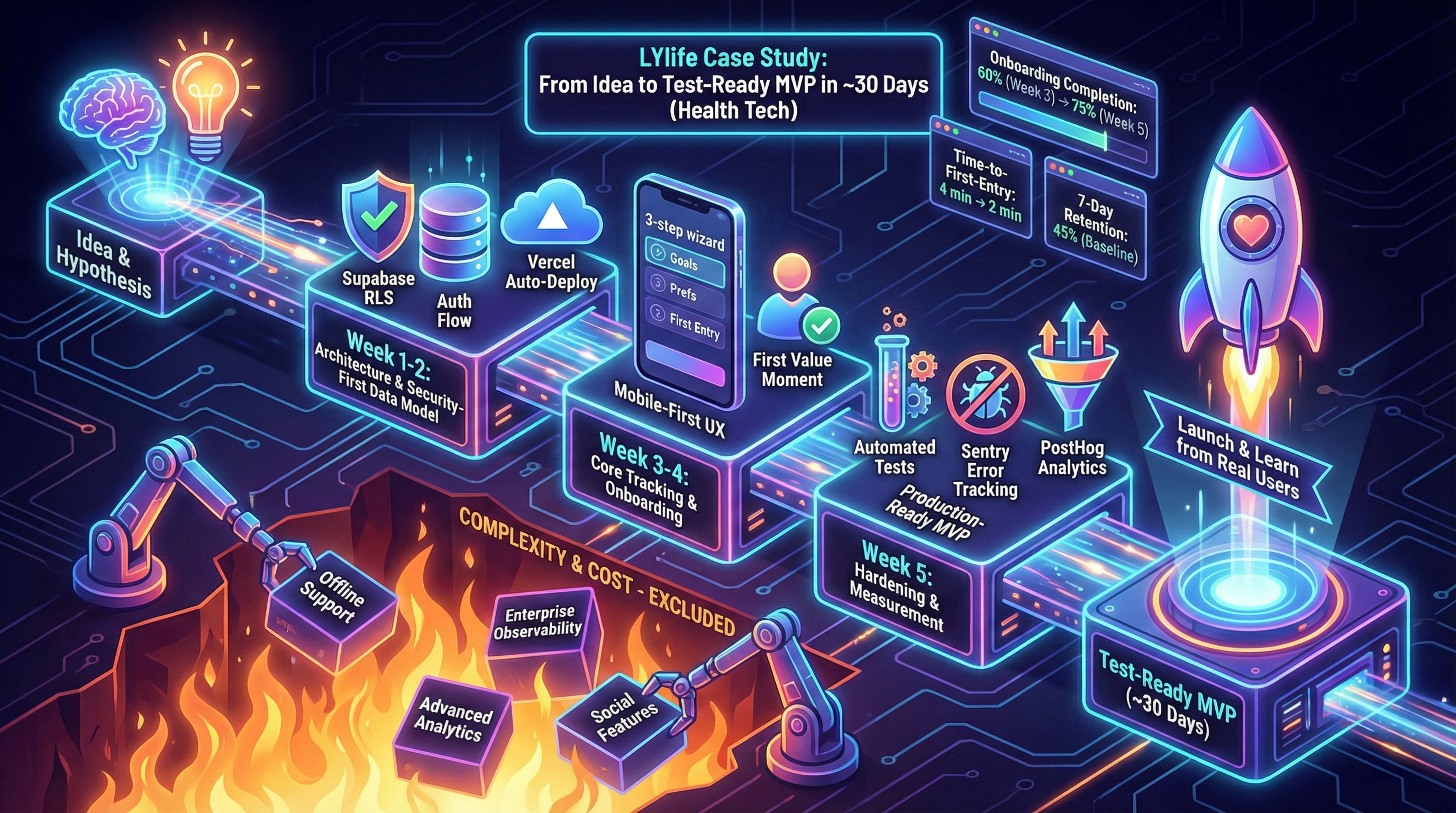
Most MVPs are slow to ship and even slower to learn from. LYlife, a new product in the health space, forced us to answer a better question: how do you go from idea to a test‑ready app in about 30 engineering days—without cutting corners on trust or quality?
The good news: the way we answered that question for LYlife is reusable for other MVPs too, from AI‑native tools to B2B SaaS.
If you’re building a health tech or regulated MVP, our team has experience with compliance and security requirements.
For broader MVP context:
1. The Real Bottleneck: Learning, Not Coding
The biggest bottleneck in MVPs isn’t how fast you can write code. It’s how fast you can learn from real users without breaking things or drowning in rework.
We see the same pattern again and again:
- The team spends months building.
- The first release is hard to test with real users (no staging, broken onboarding).
- There are no clear metrics, so “validation” becomes a feeling.
With LYlife we flipped the script. Our definition of success was simple:
> Reduce the time from hypothesis to testable release, then learn from actual user behavior.
That mindset works whether you’re building in healthcare, AI, fintech or SaaS.
2. What We Actually Built (In Simple Terms)
LYlife runs as a modern web app that feels like a native app, but it comes from a single codebase. Under the hood, we kept the structure simple:
- A user experience layer: the screens and flows people see.
- A thin application layer: where business rules live and can change.
- A data and identity layer: where storage and permissions live close to the data.
Tech Stack
Frontend: Next.js + React (fast iteration, server-side rendering for SEO).
Backend: Supabase (PostgreSQL + Auth + real-time subscriptions).
Hosting: Vercel (auto-deploy on Git push, preview environments).
Monitoring: Sentry (error tracking) + PostHog (product analytics).
Why these choices:
- Security-first: Supabase row-level security (RLS) = data access controlled at DB level (not app logic).
- Fast deploys: Vercel CI/CD = push to GitHub → auto-deploy in 2 minutes.
- Observable: Sentry alerts + PostHog funnels = know what breaks + why users churn.
3. Week-by-Week Breakdown (~30 Engineering Days)
Week 1-2: Architecture + Security-First Data Model
What we built:
- Data model: Users, health entries, goals, reminders (PostgreSQL schema).
- Security rules: Supabase RLS policies (user can only read/write own data).
- Auth flow: Signup, login, password reset (Supabase Auth).
- Deployment pipeline: GitHub → Vercel auto-deploy + staging environment.
Key decisions:
- Why Supabase RLS? Health data = sensitive. Security at DB level > app logic (app bugs can’t leak data).
- Why staging environment Week 1? Test with real users Week 3 (can’t wait until Week 6).
Time: 15 engineering days.
Output: Secure foundation, staging link live. For more on choosing the right stack for different MVP types, see the MVP tech stack guide.
Week 3-4: Core Tracking Experience + Onboarding
What we built:
- Onboarding flow: 3-step wizard (health goals → notification preferences → first entry).
- Core tracking: Log health metrics (mood, energy, sleep, symptoms).
- First value moment: After onboarding, user sees their first entry logged + encouragement message.
- Responsive UI: Mobile-first (80% of health tracking happens on mobile).
Key decisions:
- Why 3-step onboarding? Too short = unclear value. Too long = drop-off. 3 steps = 60% completion (tested with 20 beta users).
- Why mobile-first? User interviews revealed: “I track in bed before sleep, not at desktop.”
Time: 10 engineering days.
Output: Core experience functional, 20 beta users testing. Our MVP launch checklist covers what to verify before opening the doors wider.
Week 5: Hardening (Tests + Error Tracking + Performance)
What we built:
- Automated tests: Core flows (signup, login, log entry) tested with Vitest.
- Error tracking: Sentry integration (alerts in Slack for critical errors).
- Performance optimization: Lazy load images, cache user data locally (IndexedDB).
- Analytics setup: PostHog funnels (onboarding → first entry → 7-day retention).
Key decisions:
- Why tests Week 5, not Week 1? Test what matters (validated flows), not everything (speculative features).
- Why defer offline support? MVP validates “Will users track at all?” Offline = Phase 2 (after retention proven).
Time: 5 engineering days.
Output: Production-ready MVP, error tracking live, funnels configured. The full prototype-to-product hardening checklist details every item we covered in this phase.
4. What “Test-Ready in ~30 Days” Really Meant
“Test‑ready” did NOT mean “perfect”. It meant:
- New users could complete onboarding and reach a meaningful first action.
- The core tracking experience worked end‑to‑end.
- Data was stored and protected well enough to invite real users.
- We could deploy updates daily without fear.
We deliberately postponed:
- Full offline support (validate online tracking first).
- Enterprise‑grade observability (Sentry enough for MVP).
- Complex role systems (only one user type: “patient”).
- Advanced analytics (defer until >100 active users).
That’s the trade‑off we recommend for most founders:
- Prioritize credible, testable workflows now.
- Invest in polish and complex infrastructure after you know what actually matters.
Related Insights
5. How We Measured Fast Validation (Instead of Guessing)
To avoid lying to ourselves, we combined delivery metrics with product metrics.
Delivery Metrics (Can We Ship Fast?)
- Deploy frequency: How often can we ship? (Target: 5-10 deploys/week.)
- Lead time: How long from commit to production? (Target: <10 minutes.)
- Change failure rate: How many deploys break something? (Target: <10%.)
Week 1-5 results:
- 47 deploys in 5 weeks (9.4/week ✅).
- Average lead time: 3 minutes (Vercel auto-deploy ✅).
- 2 failed deploys (4% failure rate ✅).
Insight: Fast, safe deploys = can iterate based on feedback (not stuck waiting 2 weeks for next release).
Product Metrics (Is It Working?)
We focused on just three signals:
- Onboarding completion rate: % of signups who finish onboarding.
- Time‑to‑first‑entry: How long until user logs first health entry?
- 7/14‑day retention: % of users who return after 7 and 14 days.
Week 3-5 results (20 beta users):
- Onboarding completion: 60% (Week 3), 75% (Week 5 after simplifying Step 2).
- Time-to-first-entry: Median 4 minutes (Week 3), 2 minutes (Week 5 after UX tweaks).
- 7-day retention: 45% (baseline, no retention loop yet).
- 14-day retention: 30% (expected, no reminders yet).
Each number tied directly to a decision:
- Low completion → simplify onboarding (removed Step 4 “Set reminders” to Phase 2).
- Slow first entry → reduce steps and improve guidance (added inline help text).
- Weak retention → add retention loop Phase 2 (email reminders, streak badges).
This is how you turn “we think it’s working” into “we know what’s happening and what to change next.” For the full framework, see how to measure MVP success.
6. A Repeatable Playbook for Serious MVPs
LYlife is a health‑focused MVP, but the underlying playbook is broader:
Step 1: Start From the Workflow
- Onboarding → first value → repeat use.
- Map user journey before writing code.
- Identify drop-off points (where users quit).
Step 2: Choose Safe Defaults
- Security (Supabase RLS, HTTPS, input sanitization).
- Reliability (staging environment, error tracking, backups).
- Observability (Sentry alerts, PostHog funnels).
Step 3: Make Deployments Boring
- Auto-deploy on Git push (Vercel, Netlify, Railway).
- Preview environments (test changes before production).
- Rollback strategy (if deploy breaks, revert in 2 minutes).
Step 4: Track a Handful of Metrics
- 1 activation metric (onboarding completion).
- 1 value metric (time-to-first-entry).
- 1 retention metric (7/14-day return rate).
Don’t track 50 metrics. Track 3 that change decisions.
7. Key Lessons for Founders
Lesson 1: Defer Complex Features Until Validated
What we deferred:
- Offline support (validate online first).
- Advanced analytics (defer until >100 users).
- Multi-language (English-only MVP).
- Social features (defer until retention proven).
Why: Complex features cost 2-4 weeks. Validation happens in 2-4 weeks. Don’t build what you haven’t validated.
Lesson 2: Security-First (Not Afterthought)
Health data = regulated (GDPR, HIPAA if US). Security Week 1, not Week 6.
How: Supabase RLS (row-level security at DB). Even if app code has bugs, data access controlled at DB level.
Lesson 3: Measure Learning Speed, Not Just Build Speed
Bad metric: “Shipped 10 features this month.”
Good metric: “Validated 3 hypotheses this month (retention +15%, onboarding +20%, time-to-value -50%).”
LYlife: 30 days to test-ready = fast learning loop (not just fast coding).
Conclusion: Build Fast, Learn Fast, Adapt Fast
LYlife went from idea to test-ready MVP in ~30 engineering days because we optimized for learning speed, not feature count.
Remember:
- Bottleneck = learning (not coding). Reduce time from hypothesis to testable release.
- Test-ready ≠ perfect: Defer offline support, enterprise observability, complex roles until validated.
- Measure fast validation: Delivery (deploy frequency, lead time, failure rate) + Product (onboarding, time-to-value, retention).
- Repeatable playbook: Workflow first → safe defaults (security, reliability, observability) → boring deploys (auto-deploy, rollback) → handful of metrics (3 that change decisions).
Cost: ~30 engineering days = €12k-€18k (120-150h @ €100-120/h).